Marketplace Integration Is More Than a “Send Product” Button
Connecting an online store to a marketplace may look simple at first:
You select a product, send it to the marketplace and start selling.
But in a real integration, publishing the product is only the beginning.
As sales continue, the following data must move correctly between the systems:
- product information,
- variants,
- prices,
- stock levels,
- orders,
- shipping statuses.
A strong marketplace integration is therefore essentially a data synchronization system.
While developing marketplace integrations at IHASHOP, one of our key questions was:
If the same product is sold across multiple sales channels, where should each piece of information come from, and which system should be the source of truth?
Without answering this question, marketplace integrations can quickly turn into a complex mix of incorrect prices, stock inconsistencies and order management problems.
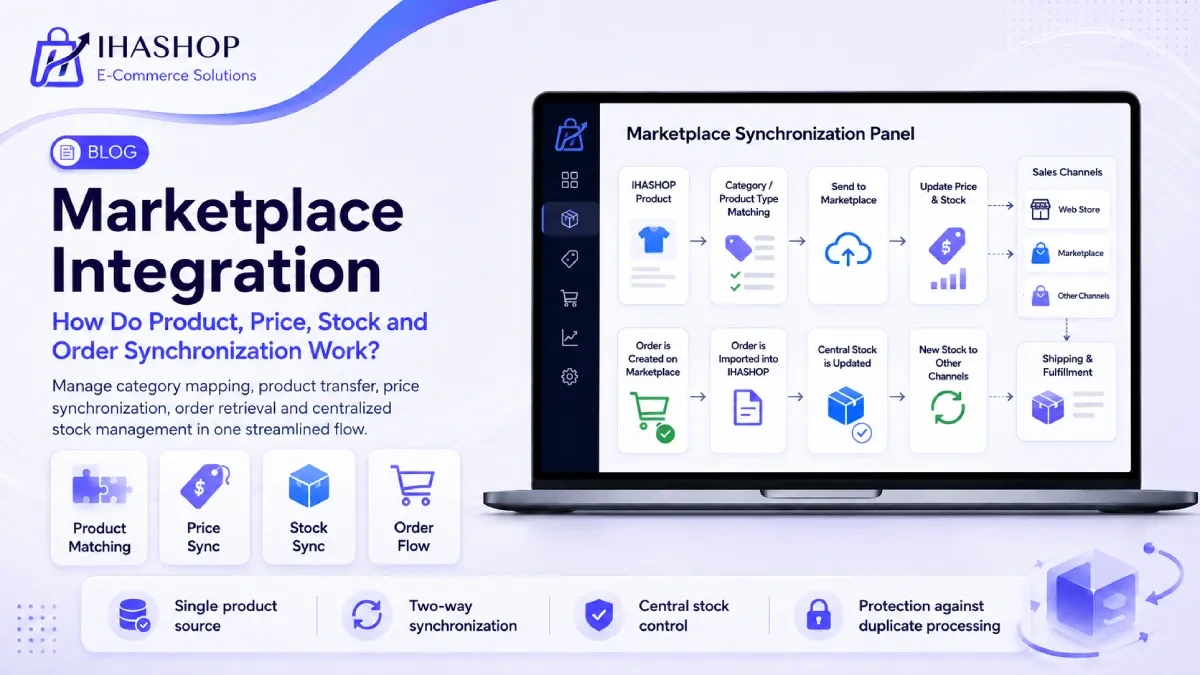
How Does the Real Flow Work?
A typical marketplace integration follows a flow similar to this:
IHASHOP Product
↓
Category / Product Type Matching
↓
Product Sent to Marketplace
↓
Price and Stock Updated
↓
Order Created on Marketplace
↓
Order Imported into IHASHOP
↓
Central Stock Updated
↓
New Stock Sent to Other Sales Channels
The important point is that the system does not operate in only one direction.
Product information moves from the store to the marketplace, while order information moves from the marketplace back to the store.
Stock may then be recalculated and distributed to other sales channels after a sale.
For this reason, describing marketplace integration simply as “product transfer” is incomplete.
1. Everything Starts with Product Matching
The category structure of an e-commerce store is rarely identical to the category structure of a marketplace.
Your store may have a category such as:
Women → Shoes → Sports Shoes
But the marketplace may expect the same product under a different category, product type or mandatory attribute set.
Amazon is a good example.
Its product structure is not based only on selecting a simple category. The required information can change depending on the product type. For this reason, IHASHOP’s Amazon integration maps product types and their required attributes before sending product data.
SKU and barcode information are equally important for product identification.
The system must always be able to answer:
Which marketplace product corresponds to this product in IHASHOP?
Without reliable matching, a price or stock update could be sent to the wrong product.
2. Price Synchronization Is More Than “Send the Same Price”
Marketplace pricing can be more complex than it initially appears.
For marketplaces operating in the same country, it may sometimes be possible to use the store price directly.
International marketplaces, however, can introduce additional variables such as:
- exchange rates,
- marketplace commissions,
- transaction fees,
- listing fees,
- advertising deductions.
We handle this issue directly in the IHASHOP Etsy integration.
The store price can be converted into the currency used by the Etsy shop. If exchange-rate information is not current, synchronization can deliberately stop rather than sending an incorrect price. Etsy-related fees can also be managed as separate pricing components.
This leads to an important principle:
A reliable integration is not a system that sends data under every condition. It is a system capable of stopping when it knows the data may be wrong.
In international commerce, delaying synchronization for a few minutes can be far safer than publishing hundreds of products using an incorrect exchange rate.
3. The Real Challenge of Stock Synchronization: The Same Product Is Sold in Multiple Places
Stock is one of the most critical areas of marketplace integration.
Consider a simple example.
You have 5 units of a product.
The same product may be available:
- on your own e-commerce website,
- on Amazon,
- on another marketplace,
- in a physical store.
If one unit is sold on Amazon, the actual stock is now 4.
But if the other channels still display 5, another customer may purchase inventory that is no longer available.
This creates the risk of overselling.
For this reason, a healthy architecture should have a single source of truth for inventory whenever possible.
The approach used in IHASHOP’s IHA CRM integration is a good example. Warehouse stock in the CRM can act as the central inventory source. When a sale takes place, stock decreases and the current quantity is synchronized back to the store. SKU and barcode matching determine which product belongs to which inventory record.
The same principle applies to marketplaces:
Sales channels may be different, but the actual sellable stock should be managed from a single source whenever possible.
4. When an Order Arrives, the Direction of Synchronization Changes
Products and prices usually move from the store to the marketplace.
Orders move in the opposite direction.
For example, an order created on Etsy can be imported into IHASHOP, where stock and order operations can continue from the central system. Shipping information can then be sent back to Etsy as the order progresses.
The flow is no longer simply:
IHASHOP → Marketplace
It becomes:
Marketplace → IHASHOP → Operations → Marketplace
This distinction is important.
A real marketplace integration is not merely an export tool that pushes products outward. It is a bridge that also brings marketplace sales back into the central e-commerce operation.
Repeated Operations Must Also Be Controlled
Network failures, API timeouts and retry attempts are normal in integrations.
If an order import operation runs twice, it should not create the same order twice.
Likewise, repeated stock updates or other critical operations should not produce duplicate commercial results.
This is closely related to the idempotency principle we discussed in payment systems.
IHASHOP’s payment infrastructure also includes controls designed to prevent the same commercial event from producing a second result. You can explore the technical approach in our article E-Commerce Payment Security: How Do We Prevent the Same Order from Being Processed Twice?.
The same principle applies to marketplace integrations:
The network request may repeat; the commercial result should not.
Every Marketplace Works Differently
One of the biggest mistakes in marketplace integration is assuming that every platform works the same way.
In reality, each marketplace may have its own:
- category structure,
- mandatory product attributes,
- authentication method,
- variant model,
- pricing rules,
- order data access,
- shipping processes.
Etsy is a good example.
In the IHASHOP Etsy integration, products can first be sent as drafts. This allows the merchant to review the title, category, images, price and other information before the listing goes live.
Amazon has different requirements.
Product types and mandatory attributes play a more important role, and an API submission being accepted does not always mean the product is immediately live. Different processing states may still need to be monitored.
For this reason, good e-commerce software should not follow the logic:
“Send the same data to every marketplace.”
Instead, the better approach is:
“Connect each marketplace’s own contract to a shared central commerce operation.”
When choosing an e-commerce platform, integration capabilities should therefore be evaluated beyond a simple feature checklist. We discuss this in more detail in our E-Commerce Software Selection: Discover the Best Platform for Your Business guide.
What Should You Check in a Marketplace Integration?
When evaluating an integration, do not ask only:
“Is this marketplace supported?”
Also check:
- Are products matched correctly using SKU or barcode?
- Is category and mandatory attribute mapping available?
- Can price and stock be synchronized?
- What happens if exchange-rate data is outdated?
- Are marketplace orders imported into the central panel?
- Can the same order be created twice?
- How is stock protected across multiple sales channels?
- Can failed product operations be identified?
- Can shipping and order statuses be sent back to the marketplace?
The answers to these questions reveal the real quality of a marketplace integration.
Conclusion
The purpose of marketplace integration is not simply to display the same product in more places.
The real goal is to reliably manage the entire:
Product → Price → Stock → Order → Operations
chain across different sales channels.
This is also the principle behind IHASHOP’s marketplace integration approach:
Sales channels may multiply, but control over product, inventory and order operations should not become fragmented.
A properly designed integration does more than add new sales channels. It keeps pricing, stock and order operations manageable from a central system.