Why Is Multilingual E-Commerce SEO More Than Translation?
When an e-commerce business expands into new markets, the first step is usually translating products, categories and content.
But from an SEO perspective, the real question is:
How will Google understand that the Turkish, English, German and Romanian pages are different language versions of the same content?
Translation alone is not enough. The following elements need to work together:
- localized URLs and slugs,
- canonical URLs,
- hreflang,
- correct language switching,
- language-specific internal links.
While developing IHASHOP’s TR, EN, DE and RO infrastructure, our core principle became:
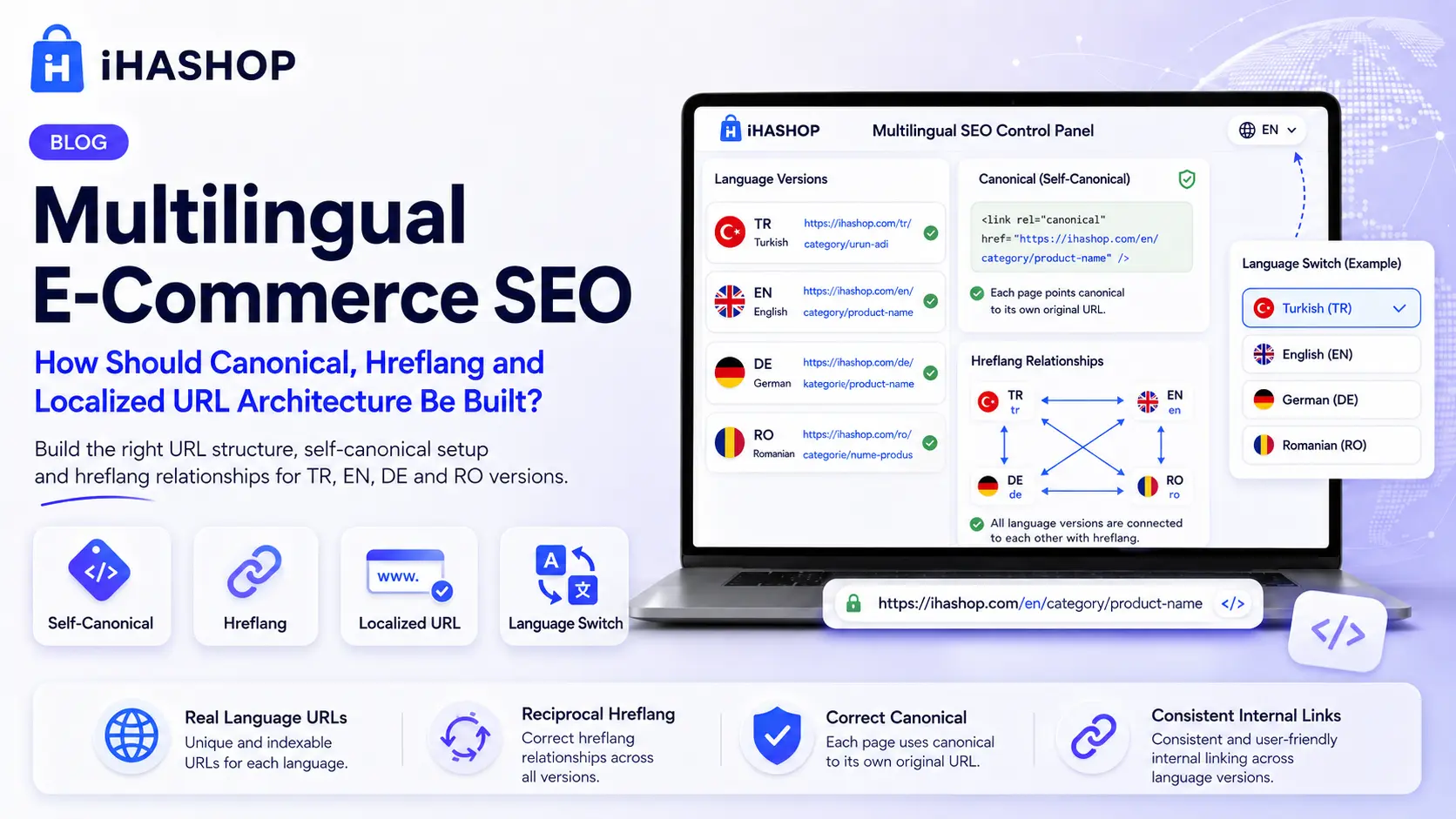
Every language version should have its own real URL while its relationship with the other language versions is clearly defined.
1. Create a Real URL for Each Language
URL structure is one of the most important parts of multilingual SEO.
For example, consider the different language versions of our Effective E-Commerce SEO Strategies article:
Turkish/blog/e-ticaret-icin-etkili-seo-stratejileri
English/blog/effective-ecommerce-seo-strategies
Romanian/blog/strategii-seo-e-commerce-magazin-online
German/blog/effektive-e-commerce-seo-strategien
The important point is that the article is not the only thing being translated.
The URL is also localized for the target language.
Using a meaningful English URL for an English article creates a cleaner structure than keeping a Turkish slug.
At IHASHOP, we follow this approach for slug-based content such as blog posts, knowledge base articles, themes and modules.
2. Canonical and Hreflang Have Different Roles
Canonical and hreflang are often confused in multilingual websites, but they solve different problems.
Canonical tells search engines:
“This is the preferred URL for this page.”
Hreflang tells them:
“These are the alternative language versions of this content.”
If an English page is a real, indexable and independent version, its canonical should point to its own English URL rather than to the Turkish page.
The correct logic is:
TR page → TR canonical
EN page → EN canonical
RO page → RO canonical
DE page → DE canonical
These genuine language pages are then connected to each other through hreflang.
This helps search engines understand both the URL identity of each page and the relationship between its language versions.
Hreflang should be reciprocal
If the Turkish page points to the English version, the English page should also point back to the Turkish version.
In other words:
TR → EN
and
EN → TR
should both exist.
For large multilingual e-commerce websites, centrally generating hreflang is therefore safer than managing every page manually.
3. Do Not Create Fake Language Versions for Missing Translations
This is one of the areas we pay particular attention to at IHASHOP.
If an article has Turkish, English and Romanian versions but the German translation has not been published yet, a German hreflang should not be generated simply because the website supports four languages.
Our approach is straightforward:
Real translation exists → include it in hreflang.
No real translation exists → do not include it as a language alternative.
The same principle applies to the user experience.
If a visitor selects German, they should not be shown content that is actually still in English or Turkish.
Language switching should work like this whenever possible:
Turkish article → English version of the same article
English product → German version of the same product
Sending users back to the homepage every time they change languages technically changes the language, but it also breaks the content context.
4. Internal Links Should Match the Active Language
Multilingual SEO does not end with canonical and hreflang tags.
Links inside the content should also use the reader’s current language whenever possible.
For example, an English article should link to the English version of another article instead of sending the reader to a Turkish URL.
Readers who want to strengthen the broader SEO foundation can continue with our Effective E-Commerce SEO Strategies article.
Those interested in why multilingual capability should be considered when choosing a platform can also read our E-Commerce Software Selection: Discover the Best Platform for Your Business guide.
This turns internal links into natural paths for further reading rather than links added only for SEO purposes.
The Multilingual SEO Structure We Use at IHASHOP
Our approach to the TR, EN, DE and RO infrastructure can be summarized as follows:
- Create a localized URL for each language in slug-based content.
- Use the page’s own URL as canonical for every indexable language version.
- Include only real translations in hreflang.
- Connect language versions reciprocally.
- Open the corresponding version of the same content when the language changes.
- Point internal links to the correct URL for the active language.
The goal is not simply to improve a technical SEO score.
The real goal is:
To provide users and search engines with a consistent content and URL structure in every language.
Quickly Check Your Multilingual Website
If your e-commerce website supports multiple languages, ask these questions:
- Does every language version have its own real URL?
- Are slugs localized for the target language?
- Does every page use the correct canonical?
- Are hreflang references reciprocal?
- Are missing translations incorrectly included in hreflang?
- Does language switching open the correct version of the same content?
- Do internal links point to URLs in the active language?
If several answers are “no,” your multilingual architecture may still be operating mainly at the translation level.
Conclusion
The basic formula for multilingual e-commerce SEO is straightforward:
Correct translation + localized URL + self-canonical + hreflang + correct language switching + language-specific internal links
This is also the principle we follow while developing IHASHOP’s multilingual infrastructure:
Every language version should have its own URL identity, and its relationship with the other language versions should be defined correctly.
When this structure is implemented properly, users reach the right content in their language and search engines can understand the multilingual architecture more easily.