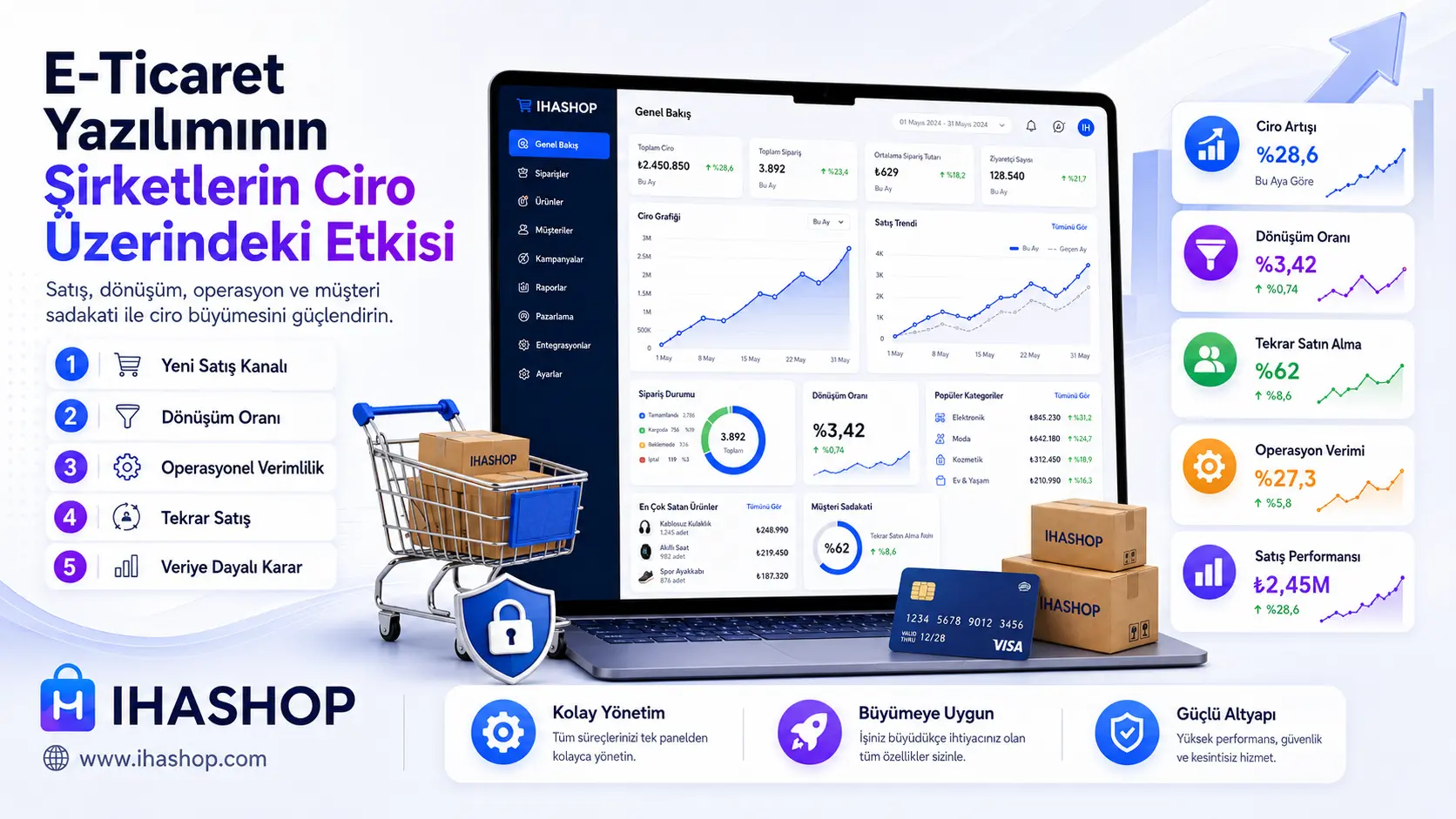
Increasing a company's revenue requires more than just driving traffic to a website. Converting existing visitors into buyers, accelerating order processing, reducing operational errors, and boosting repeat purchase rates are critical factors that directly impact the bottom line.
In this digital age, e-commerce software is not merely a technical utility; it is a strategic driver of a company's digital revenue performance. The right platform ensures structured product presentation, seamless user experience (UX), secure payment processing, and professional post-purchase management.
Today, e-commerce has evolved beyond being just an additional sales channel. When structured correctly, it becomes one of the primary revenue engines of an enterprise. Therefore, the impact of e-commerce software on business revenue must be evaluated across sales, operations, marketing, and customer loyalty.
Establishes a 24/7 Global Sales Channel
Physical stores and traditional sales models are constrained by operating hours, physical locations, and staff capacity. E-commerce software breaks these barriers, enabling businesses to showcase and sell products online 24/7.
With this infrastructure, companies can reach potential buyers globally, far beyond their local markets. Even when the physical office or store is closed, customers can browse products, place orders, and make payments. This ensures that sales opportunities are never limited by time or geography.
Establishing a digital sales channel diversifies a company's revenue streams. When supported by robust SEO, target-driven advertising, and social commerce strategies, an online store delivers consistent and scalable revenue growth.
Optimizes Conversion Rates (CRO)
Revenue growth is not solely about getting more visitors; converting existing traffic into paying customers is equally vital. This is where Conversion Rate Optimization (CRO) comes into play.
A user-friendly UI/UX design, fast site search, clean category navigation, secure checkout, and a seamless shopping cart flow significantly boost conversion rates. When visitors find products easily, see clear product information, and trust the checkout process, their purchase intent increases.
Maximizing sales from existing marketing spend directly improves profit margins. If users abandon their carts at checkout, the issue is often the shopping experience rather than traffic quality. High-performance e-commerce software streamlines this funnel, preventing lost sales.
Reduces Operational Overhead
Operational efficiency is as critical to profitability as top-line revenue growth. Scaling sales means handling more inventory, orders, customer inquiries, and payments. Managing these processes manually increases error rates and strains resources.
Centralizing products, inventory, orders, customer data, and payments into a single dashboard streamlines business operations. It enables accurate stock tracking, faster order fulfillment, and reduced manual labor.
Fewer operational mistakes lead to faster delivery times and higher customer satisfaction. Keeping operational overhead under control while scaling revenue is essential for sustainable business growth.
Drives Repeat Purchases and Customer Lifetime Value (LTV)
For sustainable revenue growth, relying solely on new customer acquisition is not enough. Encouraging existing customers to make repeat purchases is far more cost-effective and highly valuable for long-term profitability.
Advanced e-commerce software facilitates customer retention through features like customer accounts, order history tracking, automated email/SMS marketing, personalized discounts, and remarketing tools. When a customer trusts a store and enjoys a frictionless first purchase, their likelihood of returning increases.
Increasing repeat purchase rates lowers Customer Acquisition Costs (CAC), providing a more stable and predictable revenue stream.
Enables Data-Driven Decision Making
In the digital landscape, you cannot optimize what you do not measure. Tracking best-selling products, high-performing categories, abandoned carts, and campaign ROI is essential for strategic growth.
Professional e-commerce platforms provide deep analytics on sales trends and customer behavior. This data helps businesses make informed decisions rather than relying on guesswork.
For instance, if a high-traffic product isn't converting, you can optimize its price, description, or images. If a category excels, you can allocate more ad budget to it, maximizing ROI. This approach ensures that marketing and inventory budgets are utilized efficiently.
Enhances Digital Marketing Performance
E-commerce software acts as a force multiplier for marketing efforts. Built-in SEO tools, campaign managers, coupon engines, and structured blog layouts support digital marketing campaigns.
Directing ad traffic to optimized landing pages and offering clear paths to purchase improves campaign ROI. Furthermore, a strong SEO foundation drives organic traffic, balancing ad spend over time and ensuring sustainable customer acquisition.
Builds Customer Trust and Security
Trust is a major driver of online sales. Customers need to know their payment data is secure and that they will receive reliable support if issues arise.
Secure payment gateways, SSL certificates, transparent return policies, and automated order tracking build this vital trust, especially for first-time buyers. As trust increases, purchase friction decreases, leading to higher conversion rates.
Provides a Scalable Infrastructure for Growth
As businesses scale, their e-commerce needs evolve. A platform must handle increasing product catalogs, traffic spikes, and complex integrations without slowing down.
Choosing a platform that meets today's needs but limits tomorrow's growth leads to costly migrations. Scalability is key to long-term profitability, ensuring that your digital storefront grows alongside your business ambitions.
Conclusion
E-commerce software is more than a technical tool—it is the core of a modern business growth strategy. It expands sales channels, improves conversions, cuts operational costs, and drives repeat business.
The right e-commerce infrastructure allows businesses to reach more customers, optimize existing traffic, manage orders efficiently, and build sustainable digital revenue streams.
IHASHOP supports businesses in scaling their digital revenue with professional product management, conversion-optimized design, secure checkout, customer portals, and a highly scalable infrastructure. Choose IHASHOP to make your online sales processes more efficient, structured, and profitable.